
Everyone wants to talk about AI.
AI scoring models.
AI evidence reviews.
AI recommendations.
AI summaries.
But in Healthcare Value Analysis, jumping straight to AI without fixing your workflow is one of the fastest ways to create confusion instead of clarity.
I’ll say it plainly:
AI does not fix broken value analysis processes. It accelerates whatever problems already exist. And in Healthcare Value Analysis, most organizations already know where those problems live.
The Reality of Healthcare Value Analysis Today
Across health systems, Healthcare Value Analysis teams are still fighting the same battles:
• Requests coming in through emails or some clunky form built by IT, side conversations, and spreadsheets
• Incomplete or inconsistent intake data
• Evidence scattered across shared drives
• Subjective scoring that changes by committee
• Decisions that are hard to defend six months later
Now introduce AI on top of that
If the workflow isn’t standardized, AI simply magnifies the inconsistency.
If governance isn’t clear, AI creates faster ambiguity.
If documentation is fragmented, AI summaries become unreliable.
That’s not innovation. That’s risk.
AI Fails When Healthcare Value Analysis Lacks Structure
Healthcare Value Analysis is not a theoretical exercise. It’s operational. It’s regulated. And it’s accountable.
AI can assist—but only after the fundamentals are in place.
Before anyone talks about models, prompts, or automation, every Healthcare Value Analysis program needs to answer one question:
Do we have a standardized, repeatable, defensible workflow?
If the answer is no, AI is premature.
Consider the following
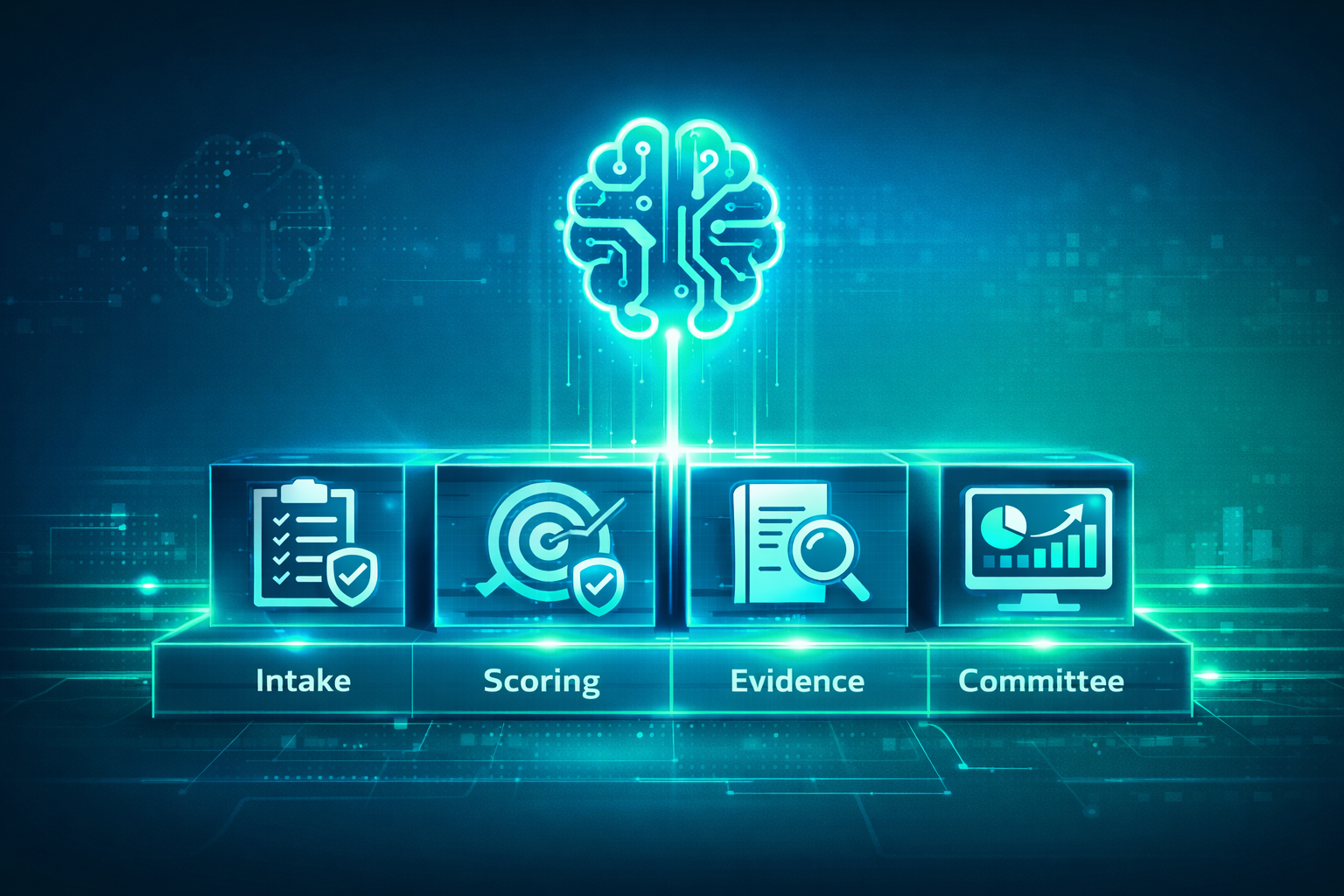
Step One: Standardized Intake Is Non-Negotiable. Every Healthcare Value Analysis request must enter the system the same way. No exceptions.
That means:
• A single intake pathway
• Required clinical, operational, and financial inputs
• Clear request ownership
• No backdoor approvals or “quick favors”
Without standardized intake, Healthcare Value Analysis becomes subjective before it even begins. AI cannot fix bad inputs — it only processes them faster.
VAMS exists to eliminate that variability at the front end, where most value analysis programs quietly break down.
Step Two: Define Scoring Before You Automate It
Scoring is where Healthcare Value Analysis exposes its weakest points.
Before AI can assist, organizations must align on:
• What criteria matter
• How those criteria are weighted
• Who owns clinical vs. financial inputs
• What qualifies as an exception
If your Healthcare Value Analysis scoring framework isn’t clearly defined and consistently applied, AI won’t improve it — it will simply institutionalize inconsistency.
Automation without alignment is just faster disagreement.
Step Three: Evidence Review Must Live Inside the Workflow
In Healthcare Value Analysis, evidence review is too often dependent on individual effort:
• Someone pulls studies
• Someone summarizes FDA data
• Someone emails conclusions
That approach doesn’t scale — and it certainly isn’t AI-ready.
Evidence must be:
• Attached to the request
• Structured consistently
• Reviewed against defined criteria
• Available to committees in full context for querying
When Healthcare Value Analysis evidence review is embedded directly in VAMS, AI becomes a multiplier instead of a liability.
Step Four: Committee Workflow Is the Backbone
This is where most Healthcare Value Analysis AI conversations fall apart.
If committee workflows aren’t clearly defined, AI has nothing meaningful to support.
Healthcare Value Analysis requires clarity around:
• Who reviews what, and when
• What triggers advancement or rejection
• How decisions are documented
• How follow-ups and implementation are enforced
AI can summarize discussions and highlight gaps, but it cannot replace governance. In Healthcare Value Analysis, defensibility matters more than speed — every time.
Why VAMS Comes Before AI in Healthcare Value Analysis
VAMS is not “anti-AI.”
It is AI-ready Healthcare Value Analysis infrastructure.
It enforces:
• Standardized intake
• Configurable scoring
• Structured evidence management
• Defined committee workflows
• A complete audit trail from request to implementation
That foundation is what allows AI to add value instead of introducing risk.
Without it, AI becomes a distraction.
With it, AI becomes an accelerator.
The Bottom Line
If your Healthcare Value Analysis AI strategy starts with technology, you’re starting in the wrong place.
Start with workflow.
Map intake → scoring → evidence review → committee workflow in VAMS.
Standardize it.
Enforce it.
Make it defensible.
Then talk about AI.
Because in Healthcare Value Analysis, intelligence does not replace process — it depends on it.
Ready to see what automation looks like in action?
Discover the power of VAMS®—click the Request a Demo button below to get started.
 Request a Demo