
By Stephen Kinsella
If you’ve spent any time leading or supporting healthcare value analysis, you already know this:
Most programs weren’t designed for scrutiny. They were designed for progress.
They were built to move requests through committees, engage clinicians, manage competing priorities, and when possible, deliver savings. For years, that was enough. But the environment healthcare organizations are operating in today has changed, and the expectations around healthcare value analysis have changed with it.
What once lived quietly in the background of supply chain operations is now squarely in view of executives, finance leaders, compliance teams, and boards. Not because healthcare value analysis is failing but because it has become too important to ignore.
The question is no longer whether value analysis decisions will be examined more closely.
The real question is: Are we ready when they are?
Scrutiny Isn’t a Threat, It’s a Signal
In many organizations, audit readiness is still viewed defensively. Something to prepare for when an external review is looming. Something to scramble through once questions start coming in.
That mindset misses the point.
In today’s environment, increased scrutiny of healthcare value analysis is a signal, not a threat. It’s a recognition that healthcare value analysis decisions sit at the intersection of cost, quality, and risk. When margins are thin and tolerance for ambiguity is low, leadership wants confidence that decisions are disciplined, consistent, and defensible.
And that confidence doesn’t come from good intentions. It comes from structure.
The Questions That Eventually Surface
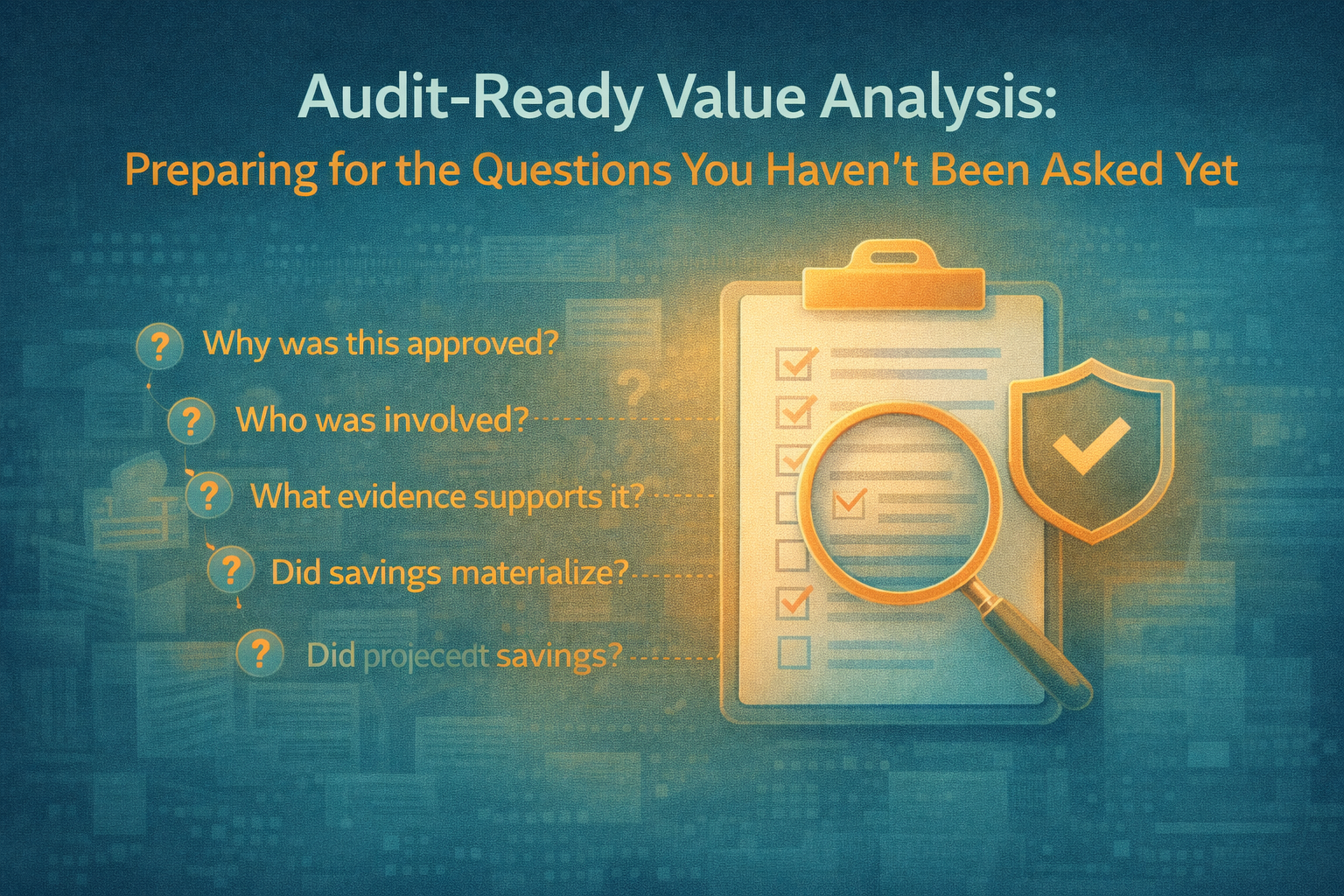
Most value analysis leaders focus, rightfully, on the work in front of them: today’s requests, this month’s initiatives, next quarter’s priorities. Audit readiness forces us to think differently. It asks us to imagine the questions that surface later, often long after a decision has been made.
Questions like:
- Why was this product approved?
- What alternatives were considered?
- Who was involved in the decision?
- What data supported the clinical and financial rationale?
- Were exceptions documented?
- Was this decision applied consistently across the organization?
- Did the projected savings actually materialize?
These are not unreasonable questions. In fact, they are exactly the questions healthcare organizations should be asking about healthcare value analysis.
The challenge is that many programs aren’t structured to answer them without significant effort.
Why Healthcare Value Analysis Often Isn’t Audit-Ready
Most healthcare value analysis programs evolved organically. Processes were built around meetings, emails, spreadsheets, and shared drives. Decisions were documented, sometimes, but rarely in a standardized, durable way.
Common patterns emerge:
- Approval rationale lives in email threads
- Supporting data is scattered across files
- Ownership changes, and context leaves with people
- Savings are reported but not traceable to decisions
- Governance varies by committee or facility
None of this reflects poor leadership or lack of effort. It reflects systems that prioritize motion over memory.
Healthcare value analysis has traditionally been about moving forward. Audit readiness requires us to also think about looking back; clearly, consistently, and confidently.
Audit-Ready Is Not a Status…It’s a Way of Operating
Here’s the shift I believe healthcare value analysis leaders must make:
Audit readiness is not something you prepare for. It’s something you operate as.
An audit-ready healthcare value analysis program doesn’t rely on reconstruction. It doesn’t depend on tribal knowledge. It doesn’t scramble to assemble a narrative after the fact.
Instead, it embeds governance into everyday work.
That means:
- Decisions are documented at the moment they’re made
- Approval paths are consistent and visible
- Roles and responsibilities are clear
- Rationale is captured, not implied
- Outcomes are tracked beyond approval
When those elements are built into the process, audit readiness becomes a byproduct of good operations, not an extra burden.
The Difference Between Activity and Accountability
One of the most common misconceptions in healthcare value analysis is equating activity with effectiveness.
Meetings are held.
Requests are reviewed.
Votes are taken.
From the outside, everything appears to be working.
But activity alone does not create accountability.
Accountability comes from being able to answer why something happened not just that it happened. It comes from connecting decisions to data, outcomes, and ownership.
Without that connection, healthcare value analysis becomes vulnerable not because decisions are wrong, but because they are hard to defend.
Why This Matters More Now Than Ever
Healthcare organizations are under unprecedented pressure to justify spend decisions with clarity and consistency. Finance leaders want confidence in savings. Compliance teams want traceability. Executives want visibility into how decisions align with strategy.
Healthcare value analysis sits in the middle of all of that.
That makes it both powerful and exposed.
Programs that cannot clearly articulate their decision logic risk being viewed as informal, opaque, or inconsistent regardless of the actual work being done. Programs that can articulate that logic earn trust and influence.
The difference isn’t effort. It’s structure.
Technology as an Enabler, Not the Answer
Technology alone does not make healthcare value analysis audit-ready. But the right technology enables behaviors that manual processes simply can’t sustain.
Purpose-built platforms like VAMS® from Data Leverage Group exist for one reason: to bring structure, governance, and visibility to value analysis work without slowing it down.
When workflows, approvals, documentation, and outcomes live in a single system, the story of healthcare value analysis becomes clear not just in real time, but over time.
That’s what audit readiness really is:
The ability to tell a consistent, defensible story about decisions, long after they’ve been made.
Preparing for Questions Before They’re Asked
The strongest healthcare value analysis programs I’ve seen don’t wait for audits, executive reviews, or external pressure to improve governance. They assume those moments will come and design accordingly.
They move from:
- Informal to intentional
- Reactive to structured
- Person-dependent to system-supported
This isn’t about fear. It’s about maturity.
Healthcare value analysis has evolved. The expectations around it have evolved. And the leaders who recognize that shift early will be the ones shaping the future of the discipline, not defending it.
Because the most important questions are rarely the ones you’re asked today.
They’re the ones coming next.
And when they arrive, healthcare value analysis should already have the answers.
Discover the power of VAMS®—click the Request a Demo button below to get started.
 Request a Demo