
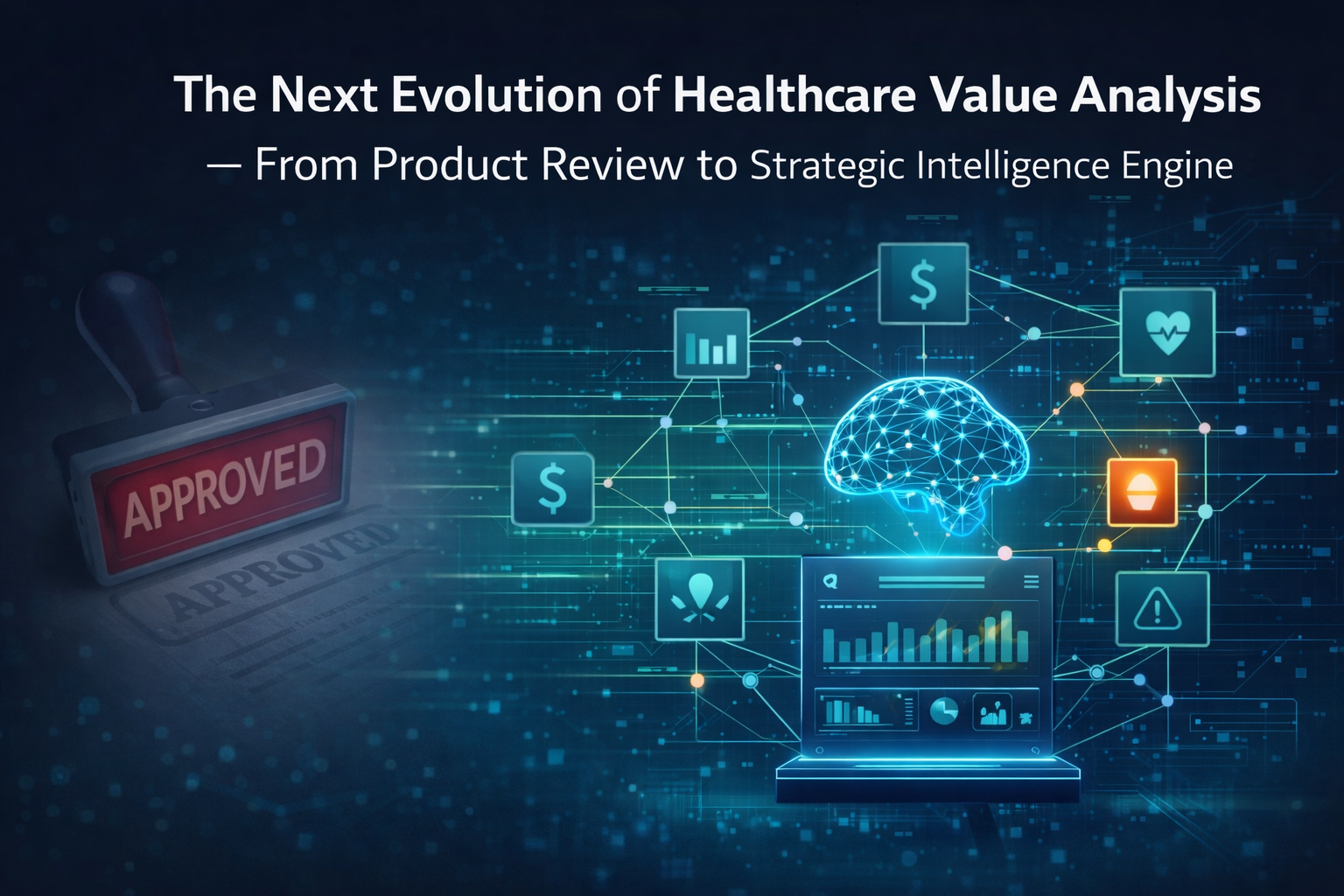
There was a time when healthcare value analysis was primarily about new product review.
Is it safe?
Is it clinically effective?
Is the price acceptable?
Approve or deny.
That era is over.
Healthcare value analysis is evolving and it must evolve into something far more strategic.
Healthcare Value Analysis Is Now a Risk Management Discipline
Modern healthcare systems operate under unprecedented pressure:
- Value-based reimbursement
- Public quality reporting
- Physician alignment challenges
- Supply chain instability
- Margin compression
In this environment, healthcare value analysis is no longer a gatekeeper function.
It is a risk mitigation and performance optimization engine.
Every product decision carries downstream implications:
- Readmission penalties
- HAC reductions
- Length-of-stay variability
- Physician satisfaction
- Clinical standardization
- Supply chain resiliency
Healthcare value analysis sits at the intersection of all of it.
The Complexity Problem
As product innovation accelerates particularly in AI-driven diagnostics, robotics, implantables, and specialty pharmaceuticals the complexity of healthcare value analysis increases exponentially.
High-complexity product requests now demand:
- Multidisciplinary stakeholder review
- Financial modeling beyond acquisition cost
- Operational workflow redesign
- Infrastructure considerations
- Human factors validation
- Ongoing monitoring post-implementation
Manual systems cannot scale to meet this complexity.
Healthcare value analysis must operate with structured frameworks and intelligent tools that match the sophistication of modern healthcare technology.
From Transactional to Strategic
If healthcare value analysis remains trapped in transactional approval cycles, it will always lag behind innovation.
The next evolution requires three strategic shifts:
- Standardized Evaluation Frameworks
Structured, tiered product evaluation models reduce variability and accelerate appropriate decision pathways.
Low-complexity items should not consume the same bandwidth as high-risk innovations.
Healthcare value analysis must differentiate intelligently.
- Embedded Intelligence
Clinical evidence frameworks, regulatory monitoring, reimbursement insight, and safety alerts must be embedded directly into the workflow.
Healthcare value analysis cannot afford disconnected systems that require manual stitching together of data.
Intelligence must live inside the process.
- Continuous Monitoring
Approval is not the finish line.
Healthcare value analysis must track:
- Actual vs. projected savings
- Clinical outcomes impact
- Contract compliance
- Utilization drift
- Safety developments
Without monitoring, value erodes.
Physician Alignment Is the Differentiator
One of the greatest opportunities in healthcare value analysis lies in physician engagement.
Historically, friction has existed because:
- Processes lacked transparency
- Data was incomplete
- Communication was fragmented
When healthcare value analysis becomes structured, data-driven, and visibly evidence-based, physician trust improves.
Trust leads to standardization.
Standardization leads to financial stability.
Financial stability protects clinical investment.
It is all connected.
The Competitive Reality
Healthcare systems that modernize healthcare value analysis will:
- Reduce approval timelines
- Improve defensibility
- Enhance patient safety
- Strengthen physician collaboration
- Drive measurable margin protection
Those that don’t will struggle under increasing complexity.
The next five years will not reward reactive systems.
They will reward organizations that treat healthcare value analysis as a strategic intelligence function not a paperwork function.
Healthcare value analysis is no longer about saying “yes” or “no.”
It is about orchestrating clinical, operational, financial, and safety intelligence into one cohesive decision-making engine.
That is the future.
And AI-enabled workflow platforms are not optional in that future they are foundational.
Discover the power of VAMS®—click the Request a Demo button below to get started.
 Request a Demo