
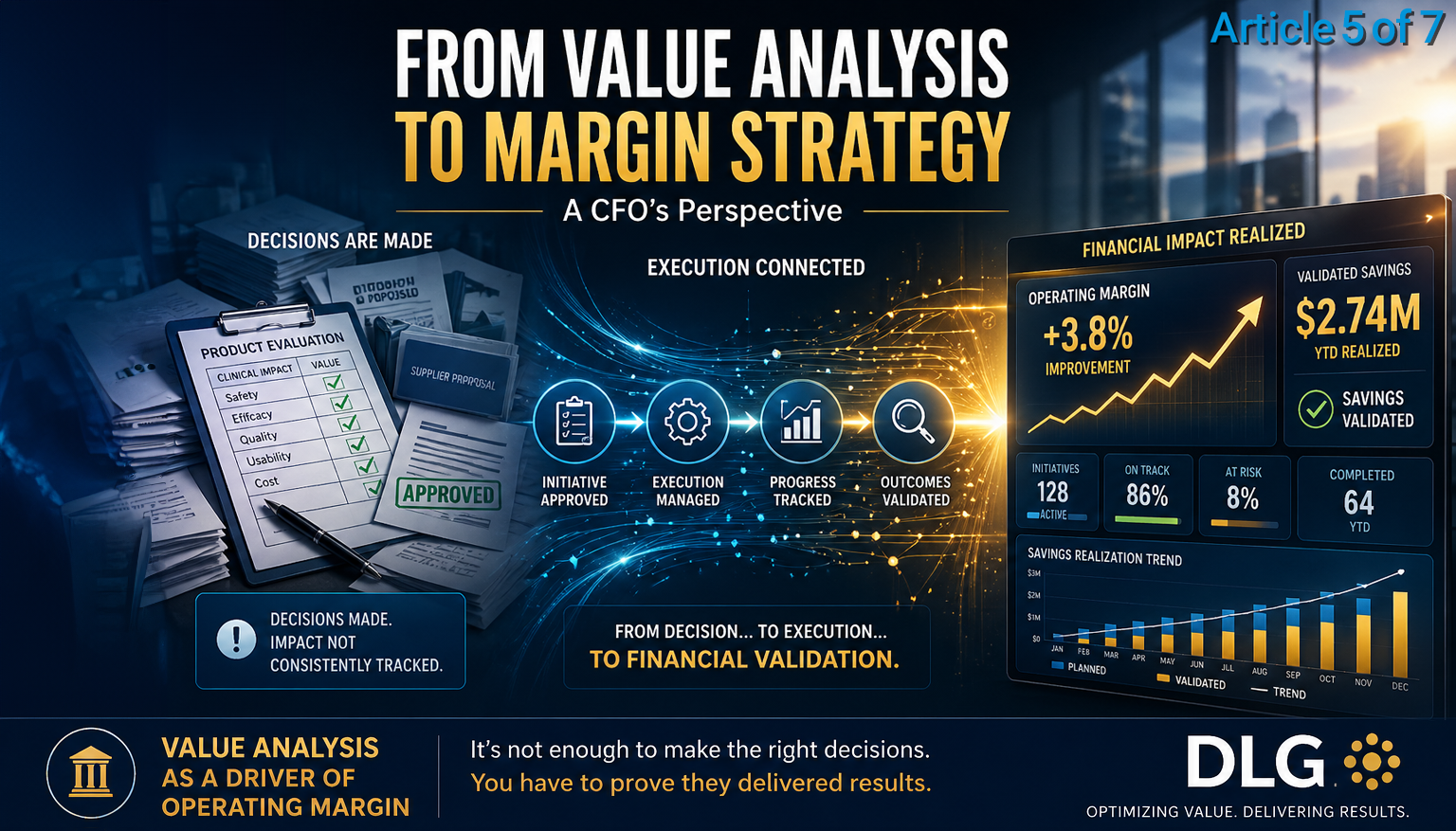
Value analysis has long been a critical function within healthcare organizations. Traditionally, it has been viewed as a process focused on evaluating products, assessing clinical impact, and supporting informed purchasing decisions.
While these responsibilities remain as core principles to successfully executing value analysis, they represent only part of the value that healthcare value analysis can deliver.
In today’s environment where operating margins are under sustained pressure there is a growing need to rethink how value analysis contributes to overall financial performance.
At its core, value analysis directly influences several key drivers of margin, including cost structure, product standardization, and operational efficiency. However, in many organizations, there remains a disconnect between value analysis activities and measurable financial outcomes.
Decisions are made, but their impact is not consistently tracked. Initiatives are approved, but their execution is not fully controlled. Savings are identified, but they are not always validated against actual performance.
This disconnect limits the strategic value of value analysis.
From a CFO’s standpoint, the focus is clear. The primary concern is not whether a product was evaluated or a decision reached (those are expected). The true measure is whether the decision produced tangible financial improvement. To answer that question consistently, value analysis must evolve beyond its traditional role.
It must become a structured system that connects decision-making to execution and execution to financial validation.
This requires several key capabilities. Organizations must establish governance across the full lifecycle of each initiative, ensuring that execution is coordinated and consistent. Processes must be standardized so that initiatives are implemented in the same way across departments and facilities. Progress must be tracked in real time, allowing leadership to understand where initiatives stand at any given moment. And most importantly, financial outcomes must be measured and validated to confirm that expected savings have been realized.
When these elements are in place, healthcare value analysis becomes more than a process. It becomes a mechanism for managing and improving operating margin.
This shift is not simply operational…it is strategic. It positions healthcare value analysis as a core contributor to financial performance, rather than a supporting function.
And as organizations continue to navigate financial pressures, that distinction becomes increasingly important.
This Is Where Value Analysis Becomes Strategy
At some point, every organization reaches the same realization:
It’s not enough to make the right decisions. You have to prove they delivered results.
That’s the shift from value analysis as a function…to value analysis as a driver of operating margin.
In the next article, we’ll take this one step further because even with visibility and strategy in place, most organizations are still missing a critical layer.
 Request a Demo