
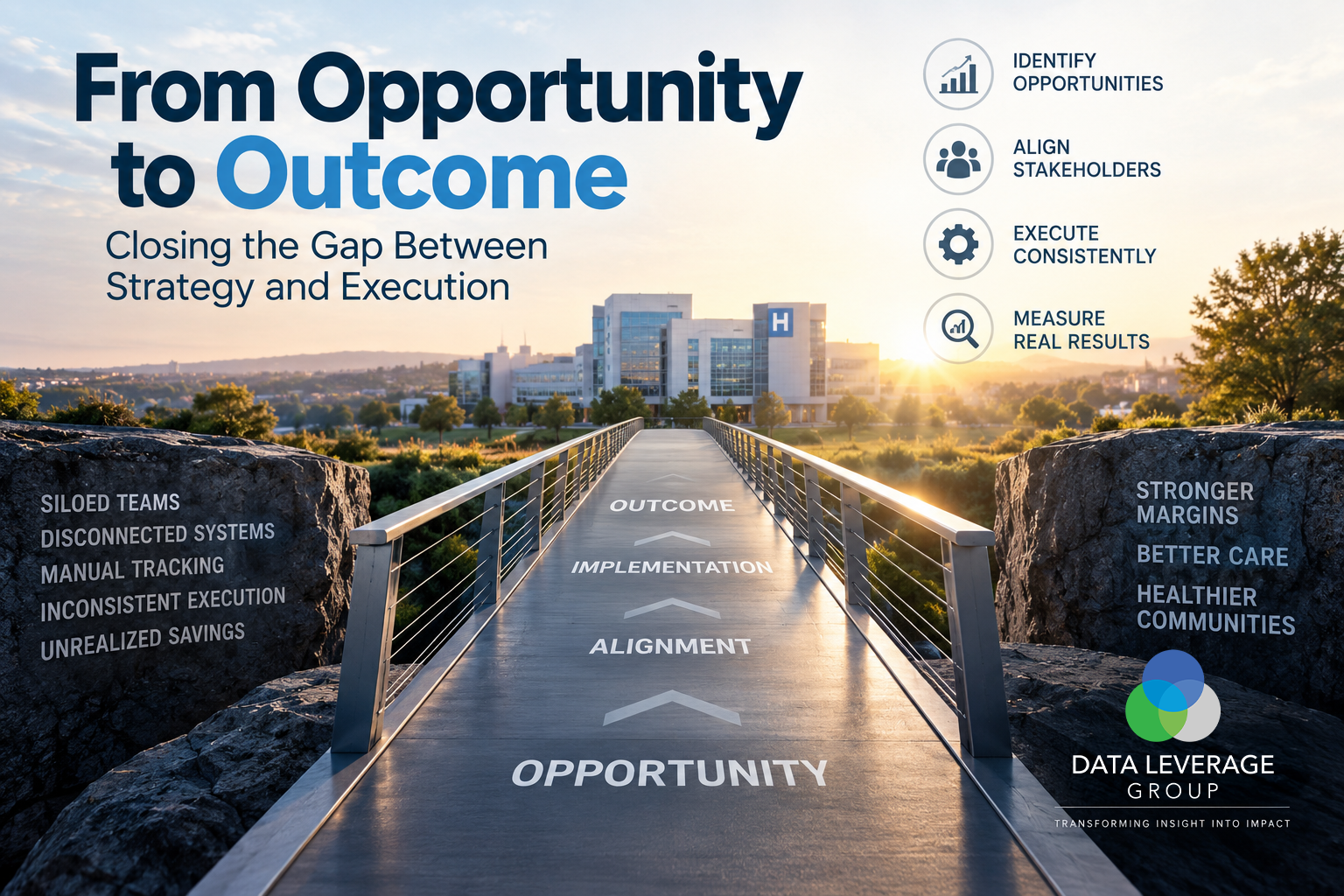
Healthcare organizations do not have an opportunity identification problem.
Most organizations already know where many of their opportunities exist. Price variation, clinical variation, contract leakage, supplier fragmentation, SKU proliferation, and utilization variation are increasingly visible.
The opportunities are rarely hidden.
The challenge is something else entirely: implementation.
Because opportunities do not improve operating margin. Implemented opportunities improve operating margin.
That distinction may matter more than ever.
The Opportunity-to-Outcome Gap
If you’ve worked enough supply chain projects, you’ve probably seen some version of the same story.
The opportunity was identified. The analytics were sound. The savings model was compelling. Stakeholders were supportive, leadership approved the initiative, and everyone agreed it made sense.
Then implementation began.
Ownership became unclear. Competing priorities emerged. Timelines shifted. Communication weakened. Stakeholders changed, and momentum faded.
Six months later, the initiative is still sitting on someone’s project list. The expected savings remain in the forecast, but the actual savings never reach the income statement.
The opportunity did not fail during identification. It failed somewhere between approval and realization.
That gap between identifying an opportunity and realizing its value may represent one of the most significant challenges facing healthcare supply chain today.
Identifying value and realizing value are two very different organizational capabilities.
Implementation Is Not an Administrative Activity
Historically, implementation has often been treated as the administrative portion of a project. The important work happened during analysis, evaluation, negotiation, and approval. Implementation was simply execution.
Reality suggests otherwise.
Implementation is where organizational complexity finally reveals itself. Contracts become item master changes. Item master changes become inventory adjustments. Inventory adjustments create education requirements. Education leads to adoption challenges. Adoption requires compliance monitoring, and compliance ultimately determines whether projected savings become realized savings.
The work does not become simpler after approval. It becomes more complicated.
That is why implementation governance should be viewed as a strategic capability rather than an administrative activity.
Implementation governance creates the structure that keeps an approved initiative moving after the decision has been made.
What Implementation Governance Actually Looks Like
Implementation governance does not require a complicated organizational structure. In practice, the fundamentals are fairly straightforward: clear ownership, defined milestones, structured communication, stakeholder accountability, implementation visibility, savings monitoring, escalation pathways, and post-implementation measurement.
None of those activities is particularly innovative on its own. Together, however, they create something extremely valuable: predictability.
Organizations that consistently realize supply expense improvements are not necessarily the organizations identifying the most opportunities. More often, they have developed the discipline to move approved initiatives through implementation with fewer gaps, fewer surprises, and greater accountability.
That distinction becomes increasingly important as the number and complexity of initiatives grow.
The advantage is not simply finding more opportunities. It is creating a repeatable way to realize them.
The Work Itself Creates the Team
As we explored in Part 3, organizational charts explain reporting relationships. Workflows produce outcomes.
That distinction becomes especially important during implementation because very few meaningful supply chain initiatives remain inside one department.
A standardization initiative may require clinicians, strategic sourcing, finance, supply chain operations, education, inventory management, technology support, and leadership alignment. The organizational chart may place those people in different functions, but the initiative brings them together around the same outcome.
No single department owns all of that work.
The work itself creates the team.
From Department Optimization to Workflow Optimization
Healthcare organizations have spent decades improving individual functions. Supply chain improved purchasing and contracting. Finance improved budgeting and financial controls. Clinical operations improved care delivery. Information technology improved systems and infrastructure.
Those capabilities remain important.
But many of the initiatives organizations are now trying to execute move horizontally across those vertical structures. Cost savings initiatives, new product requests, capital projects, technology implementations, standardization efforts, and utilization initiatives routinely cross departmental boundaries.
The friction often lives in the space between them.
That suggests an important shift in how organizations think about performance. Improving individual departments remains necessary, but improving the workflows connecting those departments may increasingly determine whether initiatives actually produce results.
Departments create accountability. Workflows create movement. Implementation governance connects the two.
Technology Is Beginning to Follow the Workflow
This shift may also help explain why healthcare organizations are evaluating technology differently than they did only a few years ago.
Historically, organizations purchased technology to support individual functions. Contract management software supported contracts. Project management software supported projects. Healthcare value analysis applications supported value analysis. Savings tracking tools tracked savings.
But initiatives rarely remain in one lane.
Projects move from sourcing to healthcare value analysis, from value analysis to implementation, and from implementation to monitoring and compliance management. The workflow itself is interdisciplinary.
As a result, organizations are increasingly looking at value analysis workflow technology through a broader lens: not simply whether a system supports one activity, but whether it can provide visibility and continuity as initiatives move from intake and evaluation through implementation, monitoring, and realization.
Technology alone will not create implementation discipline. But the right technology can support the governance, visibility, accountability, and measurement required to sustain it.
Opportunities may begin in different places. Outcomes rarely do.
The Final Question
Perhaps the question healthcare organizations should be asking is not: “How many opportunities did we identify?” Nor is it simply: “Which department owns the initiative?” A better question may be:
“How reliably can we convert opportunities into outcomes?”
Because that is ultimately what leadership expects.
The answer will not come from strategic sourcing alone. It will not come from healthcare value analysis alone. And it will not come simply from identifying more opportunities.
It requires an operating model capable of connecting opportunity identification, clinical and financial evaluation, stakeholder engagement, sourcing strategy, implementation, accountability, and measurement.
That is where implementation governance becomes important.
From Opportunity to Outcome
Over the course of this series, we have looked at the relationship between strategic sourcing and healthcare value analysis from several directions.
We began with the financial reality facing healthcare organizations and the growing importance of converting supply expense opportunities into operating margin improvement. We then examined how strategic sourcing initiatives eventually encounter healthcare value analysis and how healthcare value analysis initiatives eventually require strategic sourcing.
The common thread has been the work itself.
Strategic sourcing and healthcare value analysis remain distinct disciplines with different capabilities and responsibilities. But the initiatives they support increasingly move across both—and ultimately across many other parts of the organization as well.
Perhaps that is what this entire conversation has really been about.
Not whether one function should own the work. Not whether one discipline is more important than another. But whether healthcare organizations have built an operating model capable of moving good ideas all the way through implementation and realization.
Because healthcare organizations do not improve margins simply by discovering opportunities.
They improve margins by operationalizing change.
And in the end, that may be the most important lesson from this series:
The opportunity was never the finish line.
It was simply the beginning.
Discover the power of VAMS®—click the Request a Demo button below to get started.
 Request a Demo