
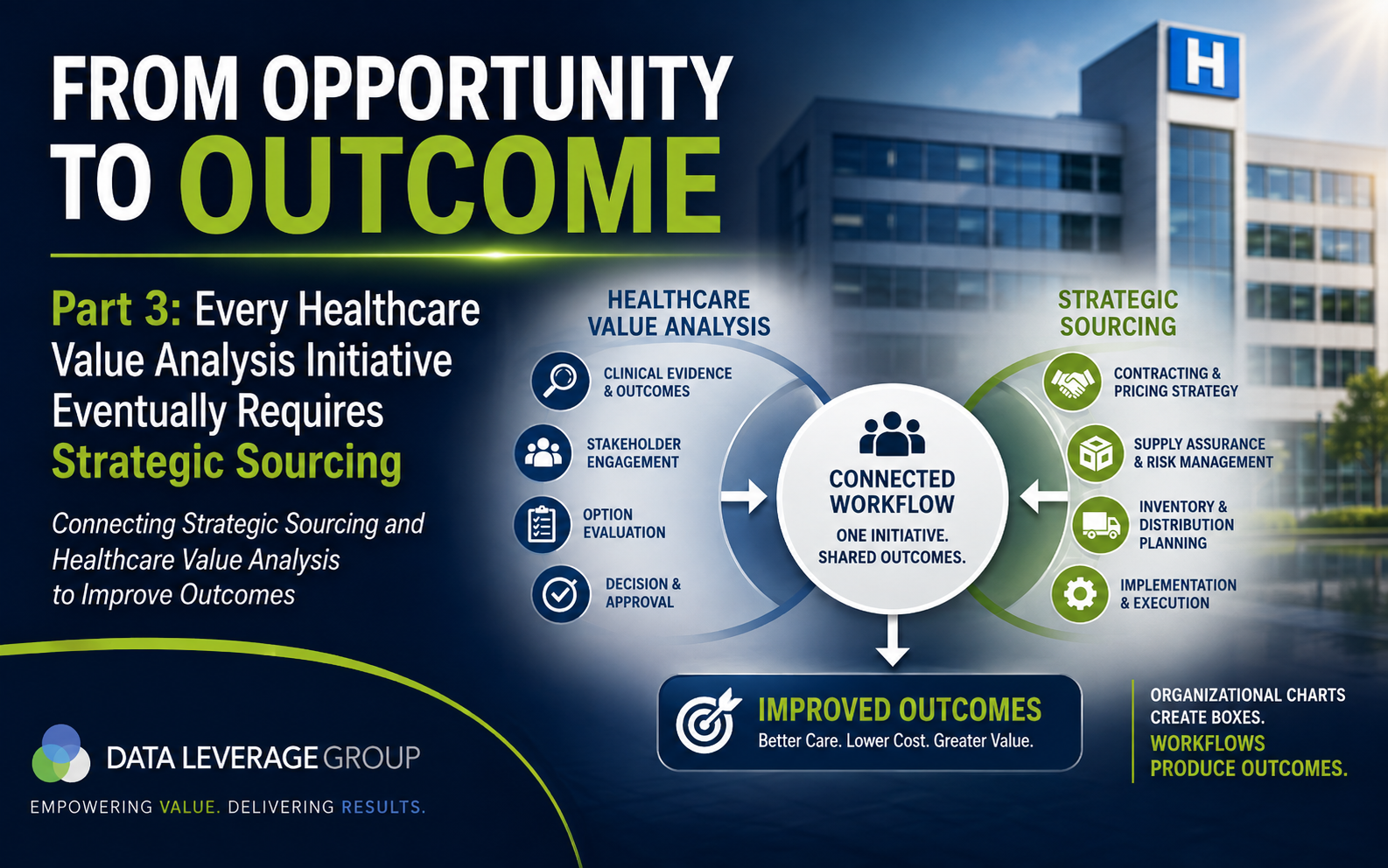
Connecting Strategic Sourcing and Healthcare Value Analysis to Improve Outcomes
Experience tends to teach the same lesson from multiple directions.
If Part 2 of this series established that every sourcing initiative eventually becomes a healthcare value analysis initiative, another question naturally follows: Does the reverse hold true?
In my experience, the answer is yes.
Healthcare value analysis excels at helping organizations answer important questions. Should we standardize? Should we convert? Should we implement this technology? Should we trial this product? Should we reduce variation or change utilization patterns?
These are precisely the types of questions healthcare value analysis was designed to answer.
But eventually another set of questions emerges. Can we contract this appropriately? Can the supplier support the conversion? Can inventory and distribution support implementation? Can supply assurance risks be mitigated? Can the pricing assumptions actually be achieved? Can the organization operationalize the decision?
Those are strategic sourcing questions, and eventually every healthcare value analysis initiative encounters them.
Healthcare value analysis determines what should happen. Strategic sourcing helps determine how successfully it happens.
The New Product Example
Consider the traditional new product request.
Healthcare value analysis evaluates the evidence, clinical stakeholders review outcomes, financial implications are assessed, operational impacts are discussed, and trials may occur. Eventually, a committee makes a decision and approval is granted.
At that moment, it can be tempting to believe the work is complete. In reality, the work may only be half finished.
Contracts require review. Pricing requires validation. Item masters need to be created. Inventory strategies and distribution requirements must be developed. Supplier onboarding may be necessary. Implementation timelines are established, education plans are coordinated, and supply resiliency considerations must be reviewed.
Only then does the organization begin realizing value from the decision.
Healthcare value analysis determines whether the organization should proceed. Strategic sourcing helps the organization successfully get there.
Physician Preference Initiatives Tell the Same Story
Physician preference initiatives may illustrate the relationship even more clearly.
Healthcare value analysis brings together clinical evidence, physician engagement, stakeholder consensus, trial outcomes, and clinical acceptance. But once direction has been established, the nature of the work begins to change.
Contracting strategies emerge. Conversion schedules are developed. Supplier commitments become important. Inventory transition plans become necessary. Existing commitments require management, and implementation sequencing becomes critical.
The clinical decision and the sourcing strategy are not separate projects. They are different stages of the same initiative.
Healthcare value analysis establishes direction. Strategic sourcing enables execution.
Technology Assessments Are No Different
The same pattern appears with capital equipment, procedural technologies, and emerging innovation.
Healthcare value analysis considers whether a technology improves outcomes, workflow, patient care, or organizational strategy. Strategic sourcing considers whether service requirements can be met, implementation resources can support deployment, reimbursement assumptions support acquisition, supplier performance can support long-term adoption, and risk can be appropriately managed.
The questions are different, but the initiative is the same.
A sound clinical decision that cannot be implemented effectively has limited organizational value. Likewise, an attractive commercial arrangement that does not stand up to clinical scrutiny is unlikely to produce a sustainable outcome.
Clinical value and commercial execution ultimately have to meet in the same workflow.
The False Choice
Healthcare organizations sometimes unintentionally create a false choice: Should this initiative be owned by strategic sourcing, or should it be owned by healthcare value analysis?
The answer is usually neither—or perhaps more accurately, both.
The initiative itself does not recognize organizational boundaries. It simply moves forward and, at different points, requires capabilities from both disciplines.
Organizations that execute well tend to recognize this earlier. Rather than spending unnecessary time defining ownership boundaries, they focus on coordinating the capabilities required to move the work forward.
The objective is not ownership. It is orchestration.
The Organizational Chart Problem
Organizational charts create boxes.
Work rarely respects them.
Healthcare value analysis may report through clinical operations in one organization, supply chain in another, and finance somewhere else. Strategic sourcing may operate independently, within supply chain, or as part of a corporate structure.
None of that changes the work itself.
Clinical evidence still requires supplier strategy. Supplier strategy still requires clinical evidence. Implementation still requires both.
The work intersects whether the organizational chart acknowledges it or not.
This may help explain why some organizations execute change more effectively than others. They have stopped treating strategic sourcing and healthcare value analysis as sequential activities and increasingly operate as though they are components of the same operating model.
Organizational charts explain reporting relationships. Workflows produce outcomes.
An Emerging Technology Requirement
This operational convergence may also explain why organizations are beginning to evaluate technology differently than they did even five years ago.
Historically, many healthcare organizations invested in tools that supported either strategic sourcing activities or healthcare value analysis activities. Increasingly, organizations are discovering that initiatives rarely remain in one lane long enough for that distinction to remain useful.
Projects move from sourcing to evaluation, from evaluation to implementation, and from implementation to monitoring and compliance management. The workflow itself has become interdisciplinary.
This is one reason organizations are placing greater emphasis on platforms and value analysis workflow software capable of supporting the lifecycle of an initiative rather than only one phase of the work.
Opportunities may begin in different places. Outcomes rarely do.
The Question That Matters Most
Perhaps the question healthcare organizations should be asking is not: “Who owns this initiative?”
A better question may be: “What capabilities are required to successfully move this initiative from opportunity to outcome?”
Increasingly, the answer includes both strategic sourcing and healthcare value analysis—not simply as sequential participants, but as connected capabilities throughout the work.
Every healthcare value analysis initiative eventually encounters the same reality:
Healthcare value analysis determines what should happen. Strategic sourcing often determines whether it successfully does.
The distinction between the disciplines still matters. But perhaps not as much as we once believed.
The final article in this series explores what may ultimately become the greatest differentiator of all: implementation governance.
Because opportunities rarely fail during identification. Increasingly, they fail somewhere between approval and realization.
That is where our conversation concludes.
Discover the power of VAMS®—click the Request a Demo button below to get started.
 Request a Demo