
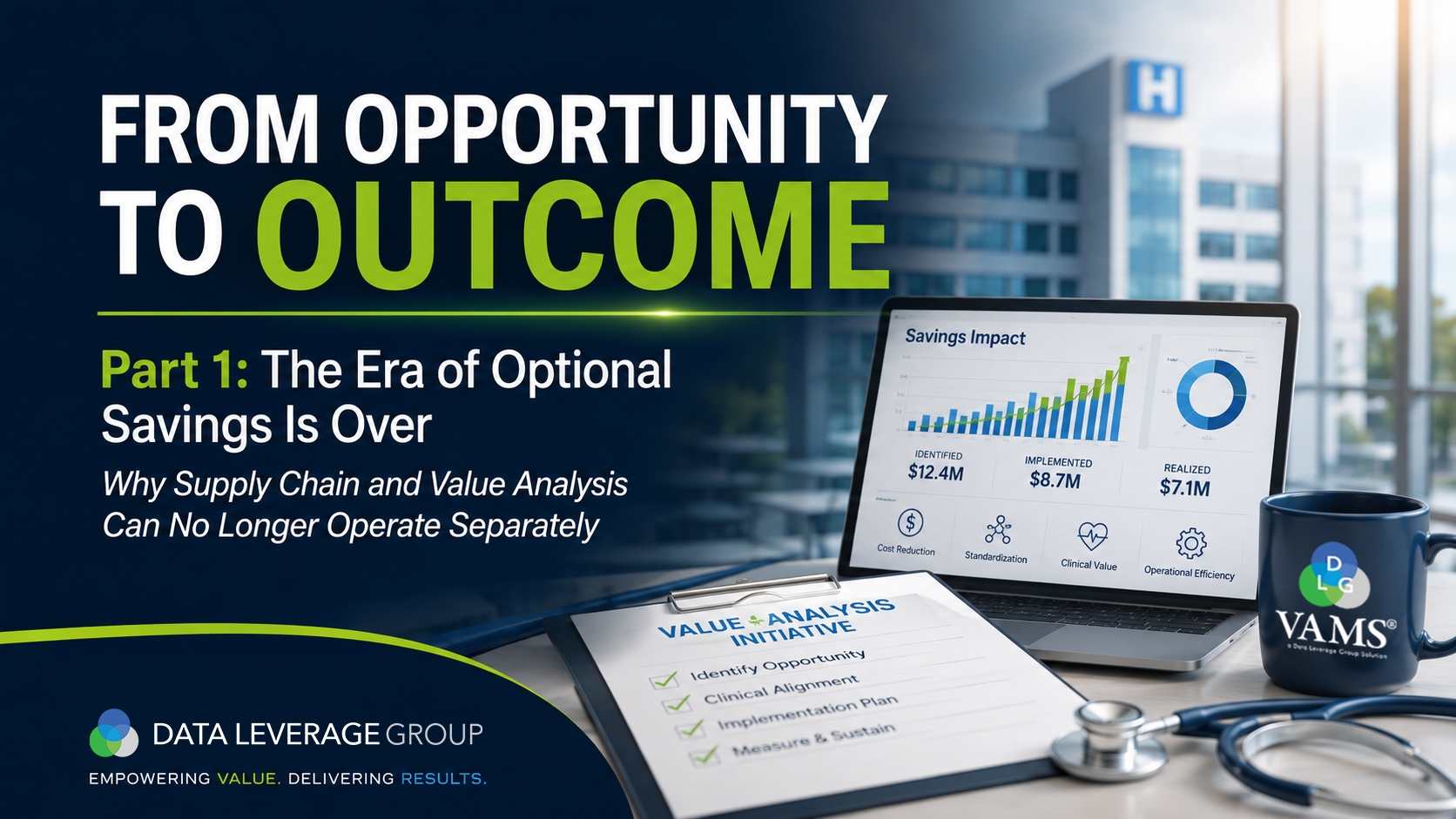
Why Supply Chain and Value Analysis Can No Longer Operate Separately
Let’s say what we already know and go from there.
Healthcare organizations today are operating under financial pressures unlike anything many leaders have experienced in their careers. Labor costs remain elevated. Reimbursement pressures continue to intensify. Supply disruptions have permanently changed how organizations think about resiliency and inventory strategy. Margins remain thin, and in some organizations, nonexistent.
At the same time, expectations have not changed.
Patients still expect exceptional care.
Physicians still expect access to technology and innovation.
Communities still expect hospitals to remain financially strong and clinically excellent.
Somewhere in the middle of all of this sits healthcare supply chain.
For years, many organizations viewed supply chain primarily as a transactional support function. Contracts needed to be negotiated. Products needed to arrive on time. Backorders needed to be managed. Inventory needed to be available when clinicians needed it.
Cost savings certainly mattered.
But for many organizations, supply cost reduction initiatives often fell into a category that might best be described as:
“Important work if time allows.”
Those days are over.
Today, identifying and implementing supply cost savings opportunities is no longer an ancillary activity that strategic sourcing and value analysis teams simply “kind of do” alongside their other responsibilities.
It has become an expectation.
Not an annual expectation.
Not a budget-cycle expectation.
An operational expectation.
Executive leadership teams now assume that healthcare supply chain organizations will continuously identify, evaluate, implement, and sustain measurable improvements in supply expense performance.
Quite frankly, they should.
Healthcare supply chain has evolved dramatically over the past two decades. The data available today would have seemed unimaginable twenty years ago. Organizations can analyze spend by physician, procedure, service line, supplier, facility, manufacturer, item number, category, and contract. Clinical variation can be identified more quickly than ever before. Utilization patterns are increasingly transparent. Opportunities for standardization and consolidation are easier to identify than at any point in healthcare history.
The visibility exists.
The expectation follows naturally.
The organizations that thrive over the next decade will not simply be organizations that manage supply expense.
They will be organizations that actively improve it.
The New Definition of Strategic Contribution:
One of the more interesting developments in healthcare leadership over the past several years has been the changing perception of supply chain’s role within the enterprise.
Historically, many supply chain leaders were evaluated based on operational effectiveness.
Were products available?
Were contracts negotiated?
Were shortages managed?
Were customers satisfied?
Those responsibilities still matter.
But increasingly, supply chain leaders are being asked different questions.
How much savings was identified this quarter?
How much savings was implemented?
How much of the forecasted savings actually reached the income statement?
What initiatives are currently in the implementation pipeline?
What barriers exist to realization?
These are not purchasing questions.
These are operating margin questions.
Supply chain has moved from being viewed primarily as a service function to becoming an increasingly important financial strategy function.
That evolution changes expectations.
It also changes accountability.
Identifying Opportunities Is No Longer the Difficult Part
Perhaps the most significant shift occurring across healthcare supply chain today is this:
Most organizations already know where many of their opportunities exist.
Price variation is visible.
Clinical variation is visible.
Contract leakage is visible.
SKU proliferation is visible.
Supplier fragmentation is visible.
Utilization variation is visible.
The opportunities are rarely hidden.
The challenge is no longer opportunity identification.
The challenge is organizational execution.
Because every opportunity that initially looks simple on paper quickly becomes much more complicated in practice.
Product standardization becomes physician engagement.
Supplier consolidation becomes operational change management.
SKU rationalization becomes workflow redesign.
Utilization management becomes clinical pathway discussions.
Contract conversions become implementation projects.
This is where many organizations encounter friction.
Not because the opportunity was wrong.
Not because the analysis was flawed.
Because healthcare organizations are extraordinarily complex environments and change requires alignment.
Alignment between clinicians.
Alignment between supply chain.
Alignment between finance.
Alignment between operations.
Alignment between leadership.
Savings opportunities do not fail because the math was wrong.
They fail because implementation is difficult.
The Industry Is Quietly Undergoing an Operating Model Transformation
There is another reality that deserves more discussion than it receives.
Healthcare supply chain is no longer simply purchasing products.
Healthcare supply chain is managing organizational change.
Every sourcing initiative creates operational consequences.
Every product decision affects clinicians.
Every implementation requires communication.
Every conversion requires stakeholder acceptance.
Every savings initiative requires governance.
The work has evolved.
Many organizations, however, continue to operate using structures that were designed for a very different environment.
Processes built for contract negotiations are now expected to manage physician alignment.
Processes built for product evaluation are now expected to deliver operating margin improvement.
Processes built for departmental decisions are now expected to support enterprise-wide standardization.
Increasingly, these legacy operating models are beginning to show strain.
The organizations responding most successfully are not necessarily the organizations with the largest supply chain teams or the largest analytic resources.
They are the organizations building repeatable processes capable of converting opportunities into outcomes.
Because ultimately, that is what leadership expects.
Not opportunities.
Outcomes.
A Different Question
For years, healthcare organizations have asked:
“How much can we save?”
That remains an important question.
It may no longer be the most important question.
The better question may be:
“How reliably can we implement change?”
Because organizations do not improve margins by identifying opportunities.
They improve margins by successfully implementing them.
That distinction matters.
Increasingly, it may become one of the defining differences between organizations that consistently achieve supply expense goals and those that struggle to realize the value they have already identified.
The Conversation We Need to Have Next:
If supply cost savings generation has become an organizational expectation rather than an optional activity, another question naturally follows:
Who owns the work?
Historically, healthcare organizations have often treated strategic sourcing and value analysis as separate functions working toward similar goals.
Reality suggests something different.
Because regardless of whether the initiative involves standardization, utilization management, vendor consolidation, SKU rationalization, clinical pathway alignment, or product conversion, the same pattern eventually emerges:
Strategic sourcing eventually requires value analysis.
Value analysis eventually requires strategic sourcing.
The distinction between the two may be far smaller than many organizations believe.
That is where our conversation continues next.
Discover the power of VAMS®—click the Request a Demo button below to get started.
 Request a Demo